 Português (Portugal)
  Español (España)
  English (United Kingdom)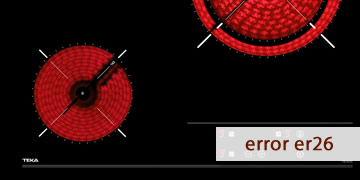
ER26 Error on Teka Ceramic Hobs
Table of contents
How to identify what ER26 is indicating on a Teka ceramic hob
The ER26 error on a Teka ceramic hob usually appears when the hob detects an electrical or electronic issue during its internal checks. In practice, the system interprets that there is a value out of range or a power control fault (for example, in the control/relay assembly or in voltage supervision) and decides to lock for safety.
That is why ER26 is often accompanied by symptoms such as:
- The hob won’t let you switch on a zone, or it stops when you try.
- The warning appears when you increase power or switch on multiple zones.
- It appears after a power cut, a sudden reconnection, or an electrical installation that “acts up” (flickering, trips, voltage drops).
In short: ER26 usually does not point to cookware or a single zone, but to a protective lock-out that can be occasional (supply-related) or persistent (electronics-related).
Guide to clearing ER26 and checks to prevent it from coming back
With ER26 it’s best to go step by step: first try to recover the system with a proper reset, then rule out external causes (moisture and power supply) and, if it continues, focus the solution on electronics/installation.
- Do a “real” reset at the electrical panel
- Switch off the hob circuit breaker.
- Wait 5–10 minutes for the hob to fully discharge.
- Restore power and test one zone at medium power for 1–2 minutes.
If ER26 was triggered by a one-off electrical event, this step is often the most effective.
- Avoid a second “brute force” attempt and note exactly when it fails
- If ER26 appears immediately on power-up, it usually points to a stable fault in the electronics/internal reading.
- If it appears when increasing power or switching on another zone, it fits better with a power-management issue or a supply that drops under load.
- Make sure the touch panel is dry and free of residual moisture
- Dry the glass and the control area thoroughly.
- If you have just cleaned it, wait a while before testing again.
- Reduce direct steam over the controls (hood/extraction), especially if you often cook with a lot of moisture.
- Rule out electrical instability at home (very relevant for intermittent errors)
- Test the hob without other high-load appliances running (oven, water heater, washing machine, dryer).
- If you notice flickering lights or breaker trips, there may be voltage variations or a loose connection somewhere.
- In older installations, a loose terminal in the junction box can cause random faults when power demand increases.
- Check whether the pattern is repeatable
- If ER26 appears always on the same action (for example, when going from power level 6 to 9), it points to a persistent fault.
- If it happens “whenever it feels like it”, it is often a mix of factors: voltage, moisture, or an intermittent contact.
- When it makes sense to call a technician
- ER26 returns after the full reset and repeats daily.
- The hob stops during normal use or behaves erratically.
- You detect repeated electrical clicking, a hot/burning smell, or cut-outs with no clear reason.
At that point, it’s reasonable to diagnose both the installation and the electronics. Often connections are checked first and, if everything is correct, attention turns to the control/power module.
If ER26 was a one-off event caused by a cut or a voltage dip, a reset at the panel and a low-load test are often enough. If the code returns under load or repeats frequently, the priority is to check the power supply and steer the diagnosis toward the electronics to prevent the lock-out from becoming routine.