 Português (Portugal)
  Español (España)
  English (United Kingdom)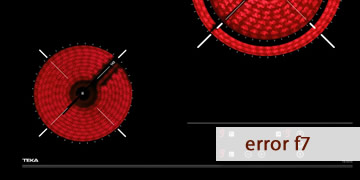
F7 Error on Teka Vitroceramic Hobs
Table of contents
How to interpret the F7 error on a Teka vitroceramic hob
The F7 error on a Teka vitroceramic hob is usually related to the main relay (or the power circuit) that enables energy delivery to the hob. Put simply, the system tries to “authorize” operation, but it detects that the relay is not closing as it should (it remains open). For safety reasons, the electronics then block use.
What you will notice when F7 appears
- The hob won’t start or it stops as soon as you try to switch a zone on
- The error shows up on power-up or right when you increase power
- In some cases, you may hear a click and then the hob immediately goes into protection
Why this code may be triggered
Most of the time, F7 is not about cookware and it is not tied to a specific zone. It is usually caused by one of the following:
- Electrical event: a brief outage, a harsh reconnection, or a voltage fluctuation that leaves the control in an abnormal state
- Poor connection: loose terminals or wiring with a bad contact that prevents the relay from closing reliably
- Power module fault: a worn relay, damaged solder joints, or compromised electronics
In short, F7 usually means the hob cannot enable power reliably, so it stops before it can operate.
How to clear F7 and what to check to prevent it from coming back
With F7, it helps to follow a clear sequence: first rule out a one-off lock, then check the electrical context, and finally decide whether you need a technical diagnosis. This avoids repeated start attempts that do not help.
- Perform a full electrical reset at the breaker panel
- Switch off the hob’s circuit breaker
- Wait 5–10 minutes to let the electronics fully discharge
- Restore power and test one zone at medium power
If F7 appeared after a brief outage or a temporary spike, this step can bring the hob back to normal.
- Check whether the error is immediate or shows up when power is demanded
- Instant F7 as soon as you power it on: this often points to a persistent control/power fault
- F7 when increasing power or turning on another zone: this fits power enable issues or a voltage drop/fluctuation under load
- Reduce electrical variables before testing again
- During the check, avoid running other heavy loads (oven, water heater, washer, dryer)
- If possible, test when the installation is “quiet” and less likely to see peaks
- If you notice flickering lights, unusual noises at the panel, or repeated trips, suspect an unstable supply
Also, if the issue aligns with other electrical symptoms, fixing the supply-side cause is often the most decisive step.
- Do not force the hob if there are signs of overheating or burning smell
- If you notice a burning smell, repeated crackling, or abnormal heat, cut the power and do not continue
- In that scenario, the risk is not the cooking zone. It is the power electronics
- When it makes sense to call a technician (and why)
- F7 returns after a full reset and repeats on every attempt
- The hob locks when power is requested even though the supply seems stable
- There have been recent interventions or there are doubts about the wiring
If the code is persistent, the usual approach is to check connections and, if those are correct, focus the diagnosis on the power module/main relay to repair or replace the affected component.
If F7 was a one-off caused by an electrical event, a full reset often fixes it. However, if it returns consistently, the most efficient path is to review the supply and move the diagnosis to the power stage to prevent recurring lockouts