 Português (Portugal)
  Español (España)
  English (United Kingdom)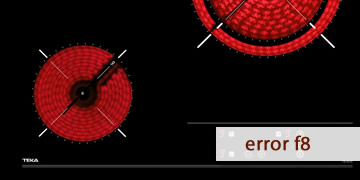
F8 Error on Teka Vitroceramic Hobs
Table of contents
What the F8 error means on a Teka vitroceramic hob
The F8 error on a Teka vitroceramic hob usually points to an open circuit in the temperature sensor. In practice, the hob “expects” a consistent thermal reading and, when it does not receive one (due to a damaged sensor, a broken wire, or a faulty connector), it activates a safety lock to avoid running without thermal control.
How it typically shows up
- The hob won’t let you turn on a zone, or it stops after a short time
- The code appears as soon as you power it on or when you try to increase power
- Operation may be irregular: it heats briefly and then goes into protection
Why it happens (common causes)
In many cases, the root cause is a reading failure rather than “incorrect use”. The most common causes are:
- A deteriorated NTC sensor (thermal fatigue over time)
- A loose or oxidized connector at the electronics
- Wiring that is pinched or cut due to heat or vibration
- An electronic module with a damaged track or solder joint that interrupts the signal
In short, when F8 appears, the hob is telling you it cannot measure temperature reliably, which is why it limits operation.
How to fix F8 and what to check to prevent it from coming back
With F8, it is best to proceed in order: first rule out a one-off control lock, then decide whether a technical intervention is needed. This reduces pointless attempts and helps avoid stressing the electronics.
- Perform a full electrical reset
- Switch off the hob’s circuit breaker at the panel
- Wait 5–10 minutes so the control can fully discharge
- Restore power and test one zone at medium power
If the code was caused by a temporary control lock, this reset may clear it.
- Identify the pattern: does it happen when cold or after warming up?
- F8 when cold (immediately): this often indicates a stable fault in the sensor/connection
- F8 after a few minutes: this can fit an intermittent connection, thermal expansion, or a fatigued solder joint
- Avoid factors that can confuse the diagnosis
- Keep the control area clean and dry (no moisture on the touch panel)
- Do not operate it with wet fingers, as this can cause erratic responses and blur the symptom
- Let the hob ventilate if there has been heat build-up under the glass
That said, when the issue is truly an “open circuit”, the key is usually the sensor signal, not the surface.
- When it makes sense to call a technician
- F8 always returns after a full reset
- The hob won’t let you cook, or it stops even under light use
- The error affects multiple zones or the behavior is unpredictable
In that scenario, the usual approach is to check the sensor, connectors, and wiring, and if those are OK, assess the related electronics. This requires internal access and, in many cases, measurement.
If F8 was a one-off event, a reset may be enough. If it repeats, the most effective solution is to verify the thermal reading chain (sensor and connections) so the hob can operate again with stable temperature control