 Português (Portugal)
  Español (España)
  English (United Kingdom)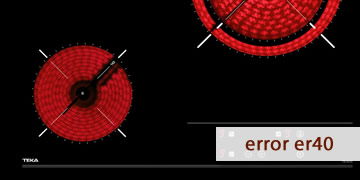
ER40 Error on Teka Induction Hobs
Table of contents
What the ER40 error indicates on a Teka induction hob
The ER40 error on a Teka induction hob usually appears when the electronics detect a temperature sensor reading that is out of range or an inconsistency in the signal that prevents safe operation of the zone. Although the exact details vary by model, nearby codes in the technical numbering often point to issues related to thermal signal management or the NTC sensors associated with each zone.
This can present as:
- The hob powers on but shortly afterwards locks and shows ER40.
- The error appears after prolonged use or a thermal fluctuation.
- It shows up after repeated resets or micro power cuts.
In practical terms, ER40 indicates that the hob cannot obtain a reliable temperature measurement to continue the cooking cycle.
How to fix the ER40 error step by step
The procedure to address ER40 is similar to other sensor-related errors, focused on ensuring normal reading conditions and correct connections.
- Switch off and let it cool down
- Turn off all zones.
- Wait 10–15 minutes for the hob and sensors to stabilize.
- Perform a full electrical reset
- Switch off the circuit breaker for a few minutes.
- Restore power before turning the hob on again.
- Make sure there is no moisture or residue
- Liquids or grease can distort thermal readings.
- Clean and dry the control area and nearby zones.
- Check whether the code affects specific zones
- If it occurs only on one zone, it may be that zone’s sensor.
- If it appears on multiple zones or the whole hob, it points to a general reading issue or a module fault.
- Contact technical service if it persists
- The error returns even after cooling and cleaning.
- The hob stops working even at low power settings.
- The fault occurs in situations unrelated to ambient temperature or usage.
Professional inspection may require checking and/or replacing the thermal sensors or the control board.
Although the exact definition of ER40 can vary by model, in many cases it is related to thermal signal or sensor issues. Addressing ventilation, resetting, and cleaning first often rules out environmental causes before moving on to more technical measures.