 Português (Portugal)
  Español (España)
  English (United Kingdom)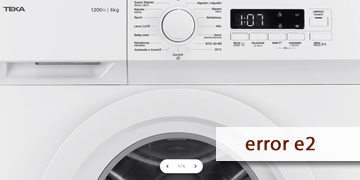
Error 2 in Teka washing machines
Table of contents
- What error 2 means in your Teka washing machine
- What to do if your Teka washing machine shows error 2
What error 2 means in your Teka washing machine
In most domestic Teka washing machine models, the error 2 code (sometimes shown as E2 or “Err2” on the display) indicates that the appliance cannot pump the water out of the drum. In other words, the control electronics order the drain phase, but the drain system does not respond as it should and the controller detects that the water level does not drop within the expected time.
Technical manuals and diagnostic charts describe this fault as a drainage or drain pump problem: the pump does not start, runs with difficulty or the water meets an obstruction somewhere along the outlet circuit.
The symptoms that usually accompany error 2 in a Teka washing machine are quite characteristic:
- The programme starts normally (filling, drum rotation) but stops before the spin cycle and shows code 2 on the display.
- When you open the door (once the machine allows it) you can see that there is still water inside the drum or at the bottom of the door glass.
- During the drain phase you may hear an intermittent humming sound or the pump straining, but hardly any water moves through the drain hose.
- On models without a display, the fault may show as two repeating flashes of the LEDs, separated by a pause, which correspond to code 2 in the diagnostic scheme.
The most common causes that explain error 2 in a Teka washing machine are:
- Drain pump filter full of debris: coins, hairpins, lint, bits of plastic, pieces of sock, etc., accumulate in the filter area and block the flow of water.
- Objects trapped in the pump: even if the filter does not look very dirty, a foreign object may have reached the pump impeller and be preventing it from turning freely.
- Blocked or kinked drain hose: the hose that carries the water to the household drain may be bent, squashed behind the washing machine or partially clogged with residues.
- Household drain line saturated: the trap or pipe in the house does not drain properly and the water “backs up” or drains very slowly, leading the electronics to interpret that the machine is not draining.
- Worn or faulty drain pump: over time, the pump may lose power, become blocked by compacted dirt or suffer a burnt-out winding, so it barely pushes water out.
- Wiring or connector issues around the pump: a loose terminal, bad contact or broken wire may cause the pump to work intermittently or not receive power at all.
- Faults in the level control system: if the pressure switch or level tube is blocked, the control board may “think” there is still water inside even when the drum is almost empty, and keep error 2 active.
In short, when your Teka washing machine shows error 2, it is telling you that it is having trouble draining the water and that you need to check the entire drain circuit (filter, pump, hose and household drain) before using it again as normal.
What to do if your Teka washing machine shows error 2
Although seeing an error code on the display is always worrying, in many cases error 2 can be solved with a thorough cleaning and some basic checks. Below is a step-by-step guide to tackle the problem safely.
- Stop the programme and unplug the washing machine
If the error appears in the middle of a cycle:- Press the on/off button to stop the washing machine.
- Wait for the door to unlock (this may take a few minutes if the water is hot).
- Unplug the machine from the mains before working on the filter or the back of the appliance.
- Remove excess water from the drum
If the drum is full of water or the level is still high:- Place a bucket or large bowl under the door and scoop the water out with a jug or small container.
- Keep several towels or cloths handy to soak up any spills.
- On some Teka models there is a small emergency drain hose next to the filter: if your washing machine has one, open the cap and let the water flow slowly into a container.
- Access the pump filter and clean it thoroughly
The filter is usually located at the front bottom of the machine behind a small cover:- Open the lower cover and place a shallow container or cloths just underneath.
- Slowly turn the filter cap anticlockwise so that the remaining water comes out gradually.
- When the water stops flowing, unscrew the cap completely and remove the filter.
- Rinse it under the tap, removing lint, threads, buttons, clips, coins, etc.
- With the filter removed, look into the opening and gently try to turn the pump impeller with your fingers; it should rotate freely. If you feel something hard, check whether there are objects stuck inside (always taking care not to damage the blades).
- Check the path of the drain hose
Gently move the washing machine slightly forward, without straining the hoses:- Make sure the drain hose is not kinked, stepped on or bent at very sharp angles.
- Check that the height of the household drain pipe is within the range recommended in the manual (usually around 50–80 cm from the floor); an incorrect height can make draining more difficult.
- If you suspect a possible internal blockage, you can disconnect the hose from the trap and rinse it with water at moderate pressure or blow through it to check it is clear.
- Make sure the household drain is not blocked
Sometimes the washing machine “blames” the pump when the real problem lies in the house drain:- Temporarily disconnect the washing machine hose from the trap and pour water directly into the sink drain or the standpipe where it normally connects.
- If the water drains slowly, backs up or even overflows, the house pipe is partially blocked.
- In that case, it is advisable to use a suitable drain cleaner or call a plumber before continuing to use the washing machine.
- Run a test with a short programme
Once the filter is clean, the hose checked and the household drain ruled out as the cause:- Put the washing machine back in place, plug it in and open the water supply tap.
- Select a short programme (for example, a rinse or quick wash).
- Pay attention during the drain phase: you should clearly hear the pump working and see the water flowing through the hose into the drain.
- If the cycle finishes without showing error 2, the most likely cause was a one-off blockage.
- When to suspect the pump or the control system
If, after all these checks, error 2 still appears even though the filter and hoses are in good condition:- The drain pump may be damaged (open winding, seized shaft, worn rotor).
- There may be a fault in the wiring connecting the electronic board to the pump.
- The pressure switch or level tube may also be blocked or leaking and failing to report the water level correctly.
- How to prevent error 2 from appearing again
Some simple routines will help prevent your Teka washing machine from showing this code again:- Clean the pump filter regularly, especially if you often wash clothes with pockets, workwear or textiles that shed a lot of lint.
- Get into the habit of checking pockets before loading the machine: coins, keys and small objects are the worst enemies of the drain system.
- Avoid overloading the drum; overloading generates more residue and makes water circulation more difficult.
- If you start to notice strange noises during the drain phase or see that a little water remains at the end of the cycle, check it immediately instead of waiting for error 2 to appear.
Error 2 in a Teka washing machine is usually related to drainage problems and, in many cases, can be solved with a thorough cleaning of the filter, checking the hose and making sure the household drain is clear. When the fault persists despite all this, the safest option is to call a specialist technician to check the pump, level system and electronics without putting your safety or the service life of the machine at risk.