 Português (Portugal)
  Español (España)
  English (United Kingdom)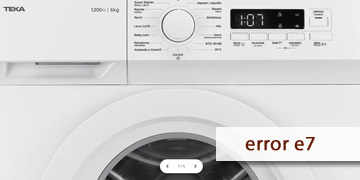
Error 7 in Teka washing machines
Table of contents
- What error 7 means in your Teka washing machine
- How to act if your Teka washing machine shows error 7
What error 7 means in your Teka washing machine
In many Teka washing machine models, error 7 (which depending on the model may appear as “7”, “E7” or “Err7”) is interpreted as a protective response against motor overheating or damage. When the control board detects that the motor is operating outside its normal safety parameters, it stops the programme and displays this code to prevent serious failure.
In practice, the appliance understands that something in the drum drive system is not right: the motor is working harder than it should, the actual speed does not match the speed demanded by the board, or the circuit that powers and controls the motor is returning abnormal readings. To protect both the motor and the electronics, the washing machine stops and shows error 7.
The most common symptoms when this code appears are:
- The programme may start normally (filling with water, initial drum movements), but stops when the drum should speed up, especially when entering the spin phase.
- You may notice abrupt speed changes, jerks or attempts to start spinning without achieving a stable rotation.
- In some cases, just before the error appears you may notice a hot or burnt smell coming from the lower area, near where the motor is located.
- On models without a display, the fault may be indicated by seven flashes or a specific light pattern that the manual interprets as error 7.
Although each product line can have its nuances, the general logic of error 7 in Teka washing machines can be summarised as follows: the electronics have detected that the motor is overheating, is being excessively loaded or is not responding as it should, and activates a protection system to prevent it from burning out.
Behind this protection there may be various specific causes:
- Overloaded drum: a load greater than the recommended capacity forces the motor to work much harder, especially during spin, and its temperature rises quickly.
- Very unbalanced load: if all the laundry is clumped on one side, the drum vibrates more, the motor receives sudden load peaks and the protection system may be triggered.
- Mechanical problems in the drum: worn bearings, a seized drum shaft or a foreign object between tub and drum (for example, an underwire from a bra) increase friction and overload the motor.
- Worn or faulty motor: in motors with carbon brushes, very worn brushes or a damaged commutator can cause sparking, overheating and control errors; in newer motor types, faults in the windings or the speed sensor can cause similar behaviour.
- Damaged wiring or connectors: bad contacts, corroded terminals or partially broken wires between the electronic board and the motor alter current and speed readings, and the board reacts by activating protection.
- Defective electronic module that drives the motor: components such as the triac, rotation relays or the power stage itself can fail and cause the motor to be powered incorrectly.
In some specific Teka models there are slightly different interpretations of error 7 associated with the door lock or other safety protections, but the most repeated pattern in technical documentation and service experience is a protection related to the motor and its control circuit. Therefore, beyond checking the laundry load, you should bear in mind that there may be a real fault in the motor–electronics group.
How to act if your Teka washing machine shows error 7
Although error 7 points to a “sensitive” part of the washing machine (the motor), in some cases the cause is as simple as an excessive load or a machine that has been pushed too hard for a long time. Even so, it is important to follow a logical order to avoid making the problem worse.
- Stop the washing machine and let the motor cool down
As soon as the error appears:- Press the on/off button to stop the programme.
- Wait for the door to unlock naturally.
- Unplug the washing machine from the mains socket.
- Remove the laundry and check if the load was excessive
Open the door and take the clothes out:- Consider whether the amount of laundry was clearly higher than what you normally load in programmes that never give an error.
- Check if there were very heavy items (blanket, duvet, several thick jeans together) that, when wet, could have heavily stressed the motor.
- Use this to plan your future loads better: mixing large garments with lighter ones helps to balance the drum during spin.
- Turn the drum by hand and listen to how it moves
With the washing machine empty and unplugged:- Reach into the drum and turn it several times in both directions.
- The movement should be relatively smooth and even, without “hard spots”.
- If you notice strong rubbing, metallic noises or areas where the drum almost locks up, there may be a problem with the bearings, shaft or a foreign object trapped between the tub and the drum.
- Inspect the door seal and the inside of the drum
Often a small object can get stuck in a way that increases resistance to rotation:- Check the door gasket (the grey rubber around the opening), gently pulling back the folds to see if there are underwires, bra wires, coins or other hard items lodged in there.
- Look carefully at the inside of the drum and the perforations: sometimes a metal object sticks out slightly and rubs as the drum turns.
- Run a test with a very small load
If the drum turns correctly by hand and you do not see anything unusual:- Plug the washing machine back in.
- Load only 2–3 light garments (for example, a couple of T-shirts).
- Select a short programme with spin.
- Watch whether the drum speeds up normally and finishes the cycle without the error reappearing.
If the machine operates correctly with a small load, it is possible that error 7 was caused by a combination of overloading and a one-off imbalance of the laundry. Even so, it is wise to keep an eye on it for the next few washes.
- If the error appears again easily, suspect the motor or its circuit
When the code 7 reappears even with normal or small loads:- The motor may already be worn out (especially in older washing machines), with very worn brushes or windings that overheat quickly.
- There may be a connection problem between the electronic board and the motor: loose terminals, wires damaged by vibration, etc.
- A fault in the power electronics that drive the motor (triac or dedicated control module) is also possible.
- When it is advisable to call a service technician
It is a good idea to contact a professional when:- Error 7 appears in almost every programme, even with small loads.
- You hear very loud noises (banging, metallic squealing) as the spin cycle begins.
- You notice a burnt smell coming from the lower area of the washing machine.
- You see sparks in the motor area (on models with brushes), or the machine stops abruptly every time it tries to speed up.
- Tips to prevent error 7 from appearing again
Some good practices greatly reduce the risk of the washing machine activating motor protection again:- Respect the maximum load indicated by the manufacturer; avoid “cramming it full” with very heavy garments.
- Distribute the laundry by mixing large items with smaller ones to ensure a properly balanced spin.
- If you usually run several washes in a row, leave a few minutes between them so that the motor is not always working at its temperature limit.
- Do not ignore excessive vibrations or strong knocking of the washing machine; these are signs of imbalance that, over time, put a lot of strain on the motor and mechanics.
- Consider periodic check-ups if the washing machine is old or heavily used, especially to check the condition of the brushes and motor.
In summary, error 7 in a Teka washing machine usually indicates that the motor protection system has been triggered because something is not right in the drum drive. Sometimes it can be resolved by correcting usage habits and avoiding overloading, but when the fault appears frequently it is important to have the motor, mechanics and electronics checked by a specialised technician to avoid shortening the service life of the appliance.