 Português (Portugal)
  Español (España)
  English (United Kingdom)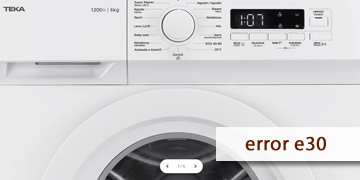
Error E30 in Teka washing machines
Table of contents
What does error E30 mean on a Teka washing machine?
Error E30 on Teka washing machines usually appears when the control board detects a door safety/lock problem. In simple terms: the washer does not receive confirmation that the door is locked (or it loses that signal during the cycle), and for safety it will not start the programme or it will stop it.
This code exists to prevent accidents and leaks: if the system cannot guarantee that the door is properly closed and locked, the washer protects itself. That’s why E30 typically appears:
- Right after pressing start: the washer tries to lock the door and fails to engage.
- Mid-cycle: the washer detects that the lock signal drops out (bad contact) and stops.
- After a “strange” locking behaviour: the door stays locked longer than normal or the lock works intermittently.
The most common causes behind error E30 on Teka washing machines are:
- Door not fully closed or something trapped in the seal (laundry, drawstring, a folded gasket).
- Worn or misaligned door latch (the piece that enters the door interlock).
- Faulty door interlock (lock): it does not lock, locks intermittently, or the internal microswitch fails.
- Sagging hinges: over time the door drops slightly and no longer aligns correctly with the lock.
- Wiring/connectors with a bad contact around the lock area (common after heavy vibration or pulling).
- Control board fault (less common): it misreads the lock signal or does not power the lock correctly.
In short: E30 usually means the washer cannot ensure the door is properly locked. Sometimes it’s solved by closing the door correctly, but if it repeats it often points to wear in the latch, hinges or the interlock.
How to fix error E30 on your Teka washing machine
Before checking anything: if the door is locked, wait for the washer to release it. For any inspection beyond the basics, unplug the washing machine.
- Check the basic door closure (fastest step)
- Open the door and make sure no laundry is trapped in the seal.
- Clean the door frame and gasket if dirt is preventing a proper seal.
- Close the door firmly until you hear a click.
If E30 disappears after this, the door was most likely not fully engaged.
- Perform a full reset
- Switch the washer off and unplug it for 2 minutes.
- Plug it back in and try a short programme.
- If the lock works “on and off”, it points to the interlock or a bad contact.
- Inspect the door latch
- Check the piece that goes into the lock: it should not be bent, broken or heavily worn.
- If the handle or latch feels loose, it may not activate the interlock microswitch reliably.
- Check if the door is sagging (hinges)
- With the door open, see if it looks misaligned compared to the frame.
- If you have to lift the door slightly to close it, it’s often a loose or worn hinge.
- Sometimes tightening screws helps; if the hinge is deformed hookup. If the hinge is bent, replacement is usually required.
- Clear signs the door interlock is faulty
- No locking click, or a very weak click.
- It locks/unlocks several times before trying to start.
- The error appears even when the door is clearly closed correctly.
- The door stays locked abnormally long, or releases “whenever it wants”.
In these cases, the most common fix is to replace the door interlock and check its connector.
- When it’s best to contact a technician
- E30 repeats every time, even after resetting.
- The door never locks, or remains locked even when the washer is off.
- You see signs of overheating, blackened plastic, or a burning smell near the lock area.
- You suspect a control board issue and don’t want to risk further damage.
A technician can test the interlock, wiring and power from the control board, avoiding “guesswork” part replacements.
- Tips to prevent E30 from coming back
- Do not slam the door or put weight on it when it is open.
- Avoid pulling the handle while the washer is still locked (wait until it releases).
- Keep the gasket and frame clean so the latch can seat properly.
- If you notice play or misalignment, address it early: bad contacts tend to get worse over time.
If you share the exact model of your Teka washing machine, I can tailor the wording to that series (some ranges label E30 as “door” and others as “lock” with small nuances, but the core meaning is usually the same).