 Português (Portugal)
  Español (España)
  English (United Kingdom)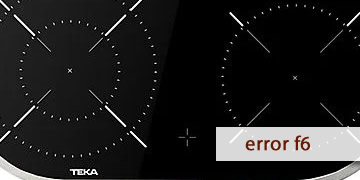
F6 Error on Teka Ceramic Hobs
Table of contents
What the F6 error means on a Teka ceramic hob
The F6 error on a Teka ceramic hob is usually related to a power supply issue between modules or an abnormality in the mains supply that causes the hob to “lose” its mains reference and lock for safety. In many incidents it is described as a cross loss of supply, especially when the unit detects that voltage is not reaching the power electronics as it should.
In practice, this error often appears in situations such as:
- After a recent installation or a reconnection at the electrical panel.
- After a micro power cut or a voltage surge/drop.
- When there are loose connections or bridging/configuration that does not match the model’s wiring diagram.
As a technical reference on Teka hobs with electronic control, the F6 code is also associated with a situation where the “generator/module” stops detecting the mains supply and the system shuts down to protect itself.
How to clear F6 and keep the hob stable
One important point: if you need to handle terminals, bridging links, or wiring to move forward, it should be done by a qualified electrician or a service technician. Still, you can follow this order to rule out the most common causes without taking risks.
- Full electrical reset (not just switching off at the panel)
- Switch off the circuit breaker/fuse for the hob circuit.
- Wait 3–5 minutes to allow the electronics to discharge.
- Restore power and test one zone at medium power.
If F6 was triggered by a one-off supply event, this reset often clears the fault.
- Check whether the error appeared after an installation or renovation
- If F6 started “from day one”, it almost always points to an incorrect connection/configuration.
- If it appeared suddenly after years of use, there is usually a supply problem or a deteriorated electrical contact behind it.
- Rule out a line/supply issue (the simple checks before dismantling anything)
- Check whether other appliances have suffered resets or flickering (a sign of micro cuts).
- If possible, try switching the hob on at a different time (for example, outside peak load hours).
- Connection and voltage checks between modules (professional only)
- Check terminal tightness and cable condition (a loose terminal causes intermittent errors).
- Confirm the connection matches the manufacturer’s wiring diagram for that model.
- Measure voltage at the required points to verify that power is reaching the power electronics correctly.
When the system detects a loss of supply between sections of the hob, it commonly locks and shows F6.
- If F6 returns after the reset, do not force it
- Avoid repeated power-on attempts “to see if it works”, as a poor connection can worsen the symptom.
- Do one test after each reset, then move on to the next step.
- When it makes sense to call the service center
- The installation has been verified by a professional and F6 persists.
- The fault appears with no clear pattern and the hob shuts off by itself frequently.
- There is an overheating smell, crackling sounds, or the breaker trips when using the hob.
In that scenario, internal electronics are assessed (modules, supply, filtering), because the error behaves like a lock-out caused by missing/abnormal mains detection.
In short: F6 is usually a warning of unstable or incorrectly distributed power within the system. If it disappears after a reset, great; if it repeats, the key is to have the connection and voltage checked against the correct wiring diagram for your model.