 Português (Portugal)
  Español (España)
  English (United Kingdom)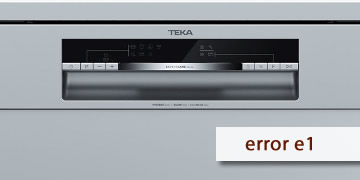
Error e1 on Teka Dishwashers
Table of contents
What the e1 error means on your Teka dishwasher
When the e1 error code appears on the display of a Teka dishwasher, the appliance is warning you about a problem with the water inlet. In other words, the machine is trying to fill but detects that the filling time is taking longer than normal or that there is not enough water flow.
Depending on the model, this same warning may be shown as e1, e01, 01 or even just 1. Although the way it is shown on the screen may vary, all these variants indicate the same type of error: the dishwasher is not receiving the water it needs within the expected time.
- Shut or partially open stopcock: if the tap that supplies the dishwasher is not fully open, the pressure and flow may be insufficient.
- Folded or pinched inlet hose: a kink in the inlet hose reduces the water flow and increases filling time.
- Blocked inlet filter: over time, limescale and particles build up in the hose filter, partially blocking the flow.
- Blocked inlet valve or Aquastop: the component that opens the water supply (inlet valve) or the safety system may fail and prevent the correct water flow.
- Low water pressure in the installation: if the water pressure in the home is very low, the dishwasher takes too long to fill and triggers the error.
- Fault in the flow meter or level sensor: if the component that “measures” the water gives incorrect readings, the appliance thinks it has not filled in time, even if water is actually entering.
How to fix the e1 error on your Teka dishwasher step by step
Below you’ll find a step-by-step guide to check the most common causes of this error on your Teka dishwasher and decide when it’s necessary to call a technician.
- Carry out a basic reset of the dishwasher
Turn the appliance off from the control panel, unplug it from the mains and wait about 5–10 minutes. Then plug it back in and select a short programme. If the code disappears and doesn’t return, it may have been a one-off reading error. If it quickly comes back, there is a real filling problem that you need to keep checking. - Check the water stopcock
Make sure the tap that supplies the dishwasher is fully open. Take the opportunity to open another cold-water tap at home and check if the water comes out with a good flow. If the pressure is low in the rest of the house as well, the problem may be in the general installation or the water supply network. - Inspect the inlet hose
Look at the back or side of the dishwasher and make sure the inlet hose is not bent, pinched or crushed by the cabinet. Sometimes, when moving the appliance or doing renovation work, the hose gets trapped and the flow is greatly reduced. - Clean the inlet hose filter
Close the stopcock, unscrew the hose from the water connection and locate the small filter (usually metal or plastic) at the inlet. Carefully remove it and rinse it under the tap to remove limescale, sand or debris. Then put it back in place, screw the hose on again and fully open the tap. - Check whether the dishwasher is trying to fill
Start a programme and listen during the first few seconds: you should hear the characteristic sound of water entering. If you barely hear it, it stops almost immediately or the control panel shows E1 / E01 / 01 again, it’s a clear sign that the flow is still insufficient or that the appliance is not “detecting” the filling correctly. - Assess the condition of the inlet valve and Aquastop
If the stopcock is fine, the hose is not bent and the filter is clean, the problem may lie in the inlet valve or the Aquastop system (if your model has one). These components can get blocked or fail, preventing the water from entering with the right flow. Checking and replacing them usually involves dismantling the appliance, so it’s advisable to have this done by a professional. - Contact technical service if the error persists
If after all these checks the dishwasher still shows these error codes, there may be a fault in the flow meter, the level sensor or the electronic control board. In that case, the safest option is to call a Teka-authorised service technician so they can measure, diagnose and replace the faulty part with full guarantees.
Dealing with the E1 error on your Teka dishwasher in time prevents the appliance from trying to run without enough water, which can damage components such as the pump or the heating elements. Keeping the water inlet clean, checking the pressure regularly and making sure the hose is not pinched are small routines that help prevent this code from appearing again.