 Português (Portugal)
  Español (España)
  English (United Kingdom)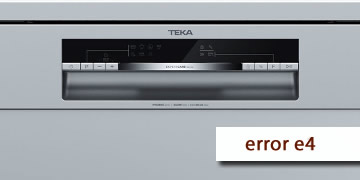
Error e4 in Teka Dishwashers
Table of contents
What error e4 means in your Teka dishwasher
In Teka dishwashers, the e4 error code is linked to a problem with overflow or water leakage. The appliance detects more water than it should have, either because the water level inside the tub has exceeded the safety limit or because water has reached the bottom tray where the anti-flood system (float and microswitch) is located.
In Teka manuals it usually appears associated with “overflow” or “leak in some part of the dishwasher”. In practice, it means that the machine has decided to protect itself and stop the wash cycle to avoid more serious damage to the appliance or to the kitchen furniture.
The most common causes that can explain this warning are:
- Water getting where it shouldn’t: a small internal leak can gradually fill the base of the dishwasher and eventually activate the safety float.
- A component that is leaking water: internal hoses, fittings, the pump housing or even the tank/tub itself may have micro-cracks or worn seals that drip during the wash cycle.
- Poor door sealing: a hardened, deformed or very dirty perimeter gasket allows water to slide down to the bottom and end up in the drip tray.
- Damaged spray arms: if one of the arms is cracked or open in some area, it may spray jets of water directly towards seals, panels or the door, encouraging leaks.
- Water level control not regulating correctly: if the water inlet does not shut off when it should (faulty inlet valve or level sensor), the dishwasher can fill above the expected level and overflow.
- Poor internal drainage: a partially blocked internal drain makes it harder for water to leave; if the level rises too much, it can escape through weak points in the tub or seals.
- Using the wrong detergent or excessive foam: hand dishwashing liquid or too much rinse aid generates a lot of foam that can reach sensors and seals and mimic an overflow situation.
- Float or safety microswitch stuck: even if there is no water left in the tray, if the float remains stuck in the raised position or the microswitch does not reset, the dishwasher will continue to “think” there is a leak.
In short, error e4 is not just any fault code: it indicates a situation where the dishwasher has detected a risk of flooding or excess water and therefore interrupts the wash cycle.
How to deal with error e4 in your Teka dishwasher
To handle error e4 properly, it is important to follow a series of checks that help you determine whether it is a one-off incident (splash, small overflow) or a real leak that requires professional attention.
- Cut the power and shut off the water supply
Unplug the dishwasher from the mains and close the water shut-off valve that feeds it. This prevents the appliance from continuing to fill or from suffering electrical damage while you inspect it. - Check if the error comes back after a full power reset
Leave the dishwasher unplugged for a few minutes, plug it back in and select a short cycle. If the e4 code reappears almost immediately, the safety system is still detecting water or an overflow issue and you should continue with the next checks. - Inspect the area around the dishwasher for signs of moisture
Look at the plinth, the floor and the sides of the cabinet:- Do you see swollen wood, limescale marks or dried water stains?
- Are there puddles or traces of water right in front of the door?
- Move the dishwasher slightly to access the base
If it is a built-in model, remove the plinth and loosen the top brackets so you can slide the appliance a few centimetres forward. You do not need to pull it out completely, but enough to be able to see, from the front or the sides, the bottom area where the drip tray is located. - Check for water in the bottom tray
At the base of the dishwasher there is usually a tray where any leaked water collects, along with a small float that triggers the anti-flood system. If you find water in that area:- Soak it up with cloths, sponges or a small manual pump until the tray is completely dry.
- Make sure the float can move freely and returns to its resting position when there is no water.
- Run a monitored test to locate the exact leak point
Put the dishwasher back in place, but keep the sides or bottom as accessible as possible. Plug it in again, open the water supply and select a short programme while you watch:- The pump area and internal drain hoses.
- The fittings and joints of the hydraulic block (the plastic assembly where water and detergent circulate).
- The bottom of the tub, in case a steady drip appears at a specific point.
- Check the door, gasket and spray arms
With the appliance switched off:- Inspect the door seal (perimeter gasket): if it is cracked, very hard or deformed, it may allow water to leak out towards the front.
- Look at the surface where the gasket sits and clean any grease, detergent or limescale that might prevent a perfect seal.
- Check the spray arms: if they are broken, split open or warped, they can spray water jets towards areas where they should not, causing leaks.
- Rule out overfilling and excessive foam
If you do not see any obvious leaks but the error keeps coming back:- Make sure you are using only dishwasher-specific detergent (never hand dishwashing liquid for the sink).
- Check the rinse aid dosage; too much can cause excessive foam.
- Observe the water level during the cycle: if it rises above the base of the filters, there may be a fault in the level control system or in the inlet valve.
- When it is advisable to call a specialist technician
It is wise to call a professional if any of the following applies:- The bottom tray fills with water again shortly after you have drained it.
- The leak clearly comes from complex internal components (tub, hydraulic block, wash pump, heat exchanger, etc.).
- Everything seems dry and in order, but the e4 error keeps appearing with no obvious cause.
- You do not feel confident removing panels or working with electrical and water connections.
Dealing with error e4 in your Teka dishwasher as soon as possible helps prevent damage to the appliance and to your kitchen caused by ongoing leaks. Keeping filters and drains clean, watching out for unusual foam and regularly checking that there are no drips at the base are simple routines that help reduce the chances of this overflow code appearing again.