 Português (Portugal)
  Español (España)
  English (United Kingdom)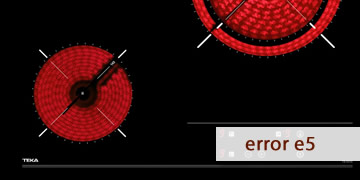
E5 error on Teka induction hobs
Table of contents
Why the E5 error appears on a Teka induction hob
The E5 error on a Teka induction hob typically points to an abnormal condition in power management within the power electronics. In practical terms, the hob detects that its internal supply (or the way mains power is stabilised/filtered for operation) is outside the expected limits, so it locks out to protect critical components.
This kind of warning tends to show up at very specific moments, because the hob “monitors” power most closely when it starts a zone or when you ask for more output:
- Right when you switch a zone on: it tries to start heating and cuts out almost immediately.
- After a power cut, repeated micro-outages, or a voltage dip/spike.
- When you increase power quickly (especially if multiple zones are already running).
- Intermittently: some days it works fine, other days it locks with no obvious pattern.
The most common causes behind E5 usually fall into one of these buckets:
- Unstable mains supply or a circuit experiencing voltage drops (shared loads, loose connections, local spikes).
- Terminal block wiring issues: poor tightening or incorrect bridging links (often after installation or replacement).
- Ageing power stage: filtering components (for example capacitors) that no longer keep values within range.
- Power module fault: the hob attempts to run, detects an abnormality and protects itself.
In short: E5 is usually more about power and electronics than cookware detection. That’s why the best approach is to start with a full reset and supply checks, and only then consider a genuine module fault.
Steps to clear the E5 error on your Teka induction hob
Induction hobs contain mains voltage and sensitive components. Do not open the appliance unless you are qualified. The checks below are safe and help you solve many E5 cases, or at least narrow the cause down.
- Do a real power cut (not just “off” on the touch panel)
- Switch the hob off from the touch controls.
- Turn the hob circuit breaker off for 2–3 minutes.
- Restore power and test one zone at medium power.
If E5 was triggered by a one-off abnormal reading after a micro-outage, this often clears it.
- Rule out an “external” lock or control issue
- Remove all cookware and clean the glass surface (avoid soaking the control area).
- Disable the child lock if your model uses it (many show “L/Lock”).
- Try powering on again using calm, deliberate touches (avoid rapid multiple taps).
- Identify the pattern: whole hob vs. a specific section
- Turn each zone on one at a time at power level 5–6 for a few minutes.
- If the same group/side always fails, it often points to the power module that drives that section.
- If nothing starts and E5 appears immediately, it more often indicates supply/primary power stage.
- If the issue started after installation/electrical work, have the wiring checked
- Confirm the hob is wired to the correct configuration (230 V single-phase or 400 V 2N, depending on the model).
- Check bridging links and terminal screw tightness: a loose terminal can cause voltage drop and heating at the block.
- Avoid sharing the hob line with heavy loads that cause dips if the circuit is not properly sized.
Many “mysterious” E5 cases come down to a connection that looks fine but isn’t correct under load.
- Test under “gentle” conditions
- Do not use Boost during testing.
- If medium power works but E5 appears when you increase output, the issue often shows up under demand (supply or power stage).
- Signs you should stop and call service
- E5 returns after a proper reset and after the installation has been verified.
- The code appears from cold, immediately on power-up, repeatedly.
- You notice clicking, a burning smell, abrupt shut-downs, or zones that stop responding.
At that point, diagnosis typically targets rectification/filtering, capacitors, the power module and internal connections, which requires measurements. Repeated attempts can worsen the damage.
- Practical tips to reduce the chance of E5 returning
- If your area suffers frequent voltage dips/spikes, consider appropriate protection at the consumer unit (in line with local regulations).
- Avoid running multiple zones at maximum for long periods if cabinet ventilation is marginal.
- If E5 appears at specific times of day, it can be a clue of supply instability in the network.
If E5 appears only once after a micro-outage, it may remain a one-off. If it starts to repeat, treating it as a supply/power-stage issue (and having it checked properly) is the fastest way to restore reliable operation without risking further damage.