 Português (Portugal)
  Español (España)
  English (United Kingdom)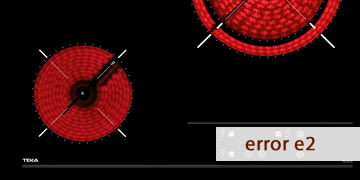
E2 error on Teka induction hobs
Table of contents
What the E2 error means on a Teka induction hob
The E2 error on a Teka induction hob usually appears when the appliance enters over-temperature protection. Put simply: the hob detects that a critical area (power stage, induction coil/inductor area, or a thermal reading used by the control) is running hotter than it considers safe, so it reduces power or locks to prevent damage.
This message often shows up in situations where heat builds up more than expected, even when it doesn’t look like you are “pushing it” from the top. Typical triggers include:
- Long sessions at high power, especially with repeated P/Boost.
- Several zones running at the same time for an extended period.
- Poor cabinet ventilation (blocked air paths, a very tight cut-out, items stored directly underneath the hob base).
- Extra heat coming from below (an oven running hard in the same cabinet, insufficient clearance between appliances).
- Cookware that stresses the zone: a warped base, too small for the zone, or inconsistent heat transfer that makes the system constantly compensate.
The key point with E2 is that it is not necessarily saying “something is broken”. It is saying: I’m getting too hot, so I’m protecting myself. If the cause is temporary, the code clears after cooling. If it happens often, there is usually a repeatable factor (ventilation/cooling/cookware) that needs addressing.
How to clear the E2 error on your Teka induction hob
As a rule, do not open the hob: it contains mains voltage and sensitive electronics. The steps below are safe and solve most E2 cases without going near internal components.
- Stop cooking and let the hob cool down
- Switch all zones off and remove the cookware if it is extremely hot.
- Wait about 15 minutes (extend to 20–25 minutes if you were using Boost or multiple zones).
- Avoid repeatedly trying to restart straight away—this can trap more residual heat.
- Perform a true power reset
- Turn the hob’s breaker/circuit off for 1–2 minutes.
- Restore power and switch on a single zone at medium power to test stability.
This helps if E2 remained latched after the thermal protection event.
- Check what’s under the hob
- If there is a drawer below, make sure no cloths, paper, trays or plastic are pressed against the hob base.
- If the hob is above an oven, avoid running both at maximum for long continuous periods.
- Look for “DIY” insulation or sealing that might be restricting airflow from the underside.
- Pay attention to the cooling fan
- It is normal for the fan to keep running after you finish cooking.
- If you never hear it, if it sounds like it is scraping, or if it runs in strange bursts, the hob may not be evacuating heat correctly.
- Adjust how you demand power
- Instead of long Boost runs, use a steady high level (for example, 7–8) and fine-tune from there.
- If you need several zones at once, drop each zone slightly to reduce total thermal load.
- Test with different cookware
- Use induction-compatible cookware with a flat base and a diameter that matches the zone.
- If E2 appears consistently with one pan but not with another, you have likely identified the practical trigger.
- When it’s better to stop troubleshooting and call a technician
- E2 appears within minutes even at medium power.
- The fan does not run or is clearly abnormal/noisy.
- The fault always affects the same zone, not the whole hob.
- You notice a burning smell or repeated abrupt shut-downs.
In those cases, a service check is usually needed (cooling fan, thermal sensors, power module), because repeated overheating eventually degrades components.
- Simple habits that often prevent a repeat
- Keep airflow clear under the hob—store nothing pressed against the base.
- Alternate power levels and allow brief pauses after intensive cooking.
- If the fan sound changes over time, address it early; it rarely improves on its own.
If E2 only appears occasionally after a heavy cooking session, it is usually just protection doing its job. If it becomes frequent, it almost always points to a repeatable cause you can isolate—airflow, cooling fan behaviour, or cookware choice.