 Português (Portugal)
  Español (España)
  English (United Kingdom)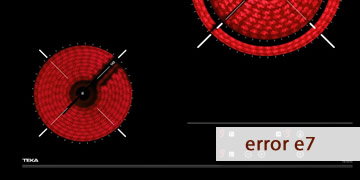
E7 error on Teka induction hobs
Table of contents
What the E7 error indicates on a Teka induction hob
The E7 error on a Teka induction hob is typically linked to an internal communication fault between the power supply/power module and the control electronics (many systems describe this as a LIN-type communication). Put simply: one section is not receiving or interpreting the expected data from the other, so the hob goes into protection rather than operating “blind”.
Depending on the series, E7 can show up in different ways:
- The hob powers on, but when you try to activate a zone it locks and displays E7.
- It works for a while and then returns after a quick restart or a power fluctuation.
- It appears right after a new installation or electrical work, without heavy usage.
- It is intermittent: some days it doesn’t appear, other days it shows up immediately.
The most common triggers tend to be:
- Micro-outages or unstable voltage leaving the electronics in an inconsistent state.
- Supply wiring issues (terminal block/bridges, loose connections, wrong 230/400 V configuration for the model).
- Internal connectors with poor contact (when the issue is recurrent and not tied to the mains supply).
- Module failure (control board or power module) when the error becomes persistent.
In short: E7 usually means “internal communication lost or unstable”. The good news is that in many cases a full power reset plus a supply check resolves it.
How to clear the E7 error on your Teka induction hob
An induction hob contains mains voltage. Do not open the appliance unless you are qualified. The steps below are safe and focus on the most common E7 causes first.
- Perform a “long” electrical reset
- Switch the hob off from the touch panel.
- Turn the hob circuit breaker off for 3–5 minutes.
- Restore power and wait a few seconds before switching on.
This is critical: with communication-type errors, a very short power cut may not reset every section properly.
- Start in a controlled way to see whether the fault appears under load
- Turn on only one zone at medium power (5–6).
- Avoid Boost during this test.
- If stable, increase power gradually.
- Rule out touch-panel related lockouts
- Clean the glass surface, especially around the controls (do not soak it).
- Remove any objects resting near the control area.
- If your hob shows “L/Lock”, disable the child lock and try again.
- If it started after installation or electrical changes, prioritise checking the terminal block
- Confirm the hob is wired according to the model diagram (230 V single-phase or 400 V 2N if applicable).
- Check bridging links are correct and terminal screws are firmly tightened.
- Avoid sharing the hob circuit with heavy loads that cause voltage dips (depending on circuit sizing).
A small wiring issue can trigger communication errors because the electronics are not receiving stable supply conditions.
- Observe whether E7 affects the whole hob or a “block” of zones
- If everything locks, a general issue (supply/control) is more likely.
- If the same side or the same zones always fail, it may point to a specific module.
- When it’s best to call a technician
- E7 returns after several full resets.
- The error appears from cold, at first power-up, repeatedly.
- It comes with abrupt shut-downs, clicking sounds, a burning smell, or zones that stop responding.
At that stage, a technician usually needs to check internal connections and diagnose the control board/power module, because the fault is likely inside the electronics rather than in usage.
- Practical habits to reduce recurrence
- If micro-outages are common, avoid rapid on/off cycles; wait a few seconds between attempts.
- Keep cabinet ventilation clear: electronics behave better when temperature stays stable.
- If the error appears after storms or grid spikes, a full reset is typically the first step.
If E7 clears after the reset and does not return in the next few uses, it was likely a one-off desynchronisation. If it keeps coming back, the most efficient approach is to treat it as a supply stability or internal communication issue to avoid repeated lockouts.