 Português (Portugal)
  Español (España)
  English (United Kingdom)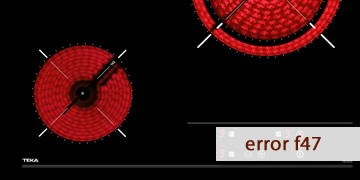
F47 error on Teka induction hobs
Table of contents
What F47 error means on a Teka induction hob
The F47 error on a Teka induction hob is usually related to a communication or synchronisation fault between the control/interface board (touch controls) and one or more power modules that drive the cooking zones. When the electronics detect that the boards are “not talking” correctly or that a section does not respond as expected, the hob may lock fully or partially to prevent unsafe operation.
Depending on the model, F47 can show up in different ways:
- The code appears and no zone can be switched on.
- Only one side or a group of zones is disabled, while the rest works.
- It appears after a power cut, a voltage spike/dip, or following electrical work/installation changes.
- The code returns in a loop even after turning the hob off and on from the panel.
The most common causes behind F47 are:
- Incorrect power supply wiring (phase/neutral miswired, wrong bridging links, missing a phase on 2N setups, loose terminal block screws).
- Unstable mains voltage or micro-outages that leave the electronics in an error state.
- Internal connectors (flat ribbon cable or wiring harnesses) with a poor contact between the interface and the power module.
- Power module failure (often tied to specific zones) or a control/interface board fault if it affects everything.
In short: F47 usually means the hob has detected an electronic inconsistency (communication/power-related) that prevents normal operation.
What to check to clear the F47 error on your Teka induction hob
Induction hobs contain mains voltage and sensitive electronics. Avoid opening the hob unless you are a qualified technician. The steps below focus on safe checks and on ruling out the most common scenarios.
- Do a full power reset (not just switching off from the panel)
- Turn the hob off from the touch controls.
- Turn the hob’s circuit breaker off (or disconnect the supply) for 2–3 minutes.
- Restore power and test again.
This often clears lockups caused by micro-outages or one-off communication glitches.
- Rule out quick “external” causes
- Remove all cookware and clean the glass surface (avoid excessive moisture).
- Make sure nothing is resting on the control area that could trigger functions or lock the panel.
- If your hob has a child lock, disable it and try switching on again.
- Check whether the fault affects the whole hob or only one section
- Try switching each zone on separately at medium power.
- If the same side or the same zones always fail, it strongly suggests a power module or its related connection.
- If nothing works and F47 appears immediately, it points more to power supply/installation or the control/interface board.
- If F47 started after electrical work, have the installation checked (electrician)
- Confirm the hob is wired to the correct scheme (230 V single-phase or 400 V 2N, depending on the model).
- Make sure no phase is missing (if applicable), neutral is correct, and bridging links are set as per the manufacturer diagram.
- Check terminal screws are tight: a loose connection can cause dropouts and intermittent errors.
This is critical if the issue began right after a change in the electrical setup.
- Watch when the error appears: “cold” or after a few minutes
- If it appears immediately, it is usually communication/power-related.
- If it appears after some time, it may be influenced by heat-related failures (modules that fail when warm), although F47 is typically a synchronisation pattern.
- When it’s best to call a technician
- F47 returns after a full power reset and after the installation has been verified.
- Specific zones remain permanently disabled or the failure is “by module/side”.
- You notice a burning smell, clicking noises, repeated sudden shutdowns, or erratic behaviour.
At that point, diagnosis usually focuses on power modules, link harness/connectors and/or the control/interface board. A technician can measure signals and internal voltages to decide whether repair or replacement is needed.
- Recommendations to reduce the chance of recurrence
- If your area has frequent voltage spikes/dips, consider appropriate protection at the electrical panel (per local regulations).
- Avoid sharing the hob circuit with loads that cause voltage drops.
- At the first signs (recurring codes after micro-outages), act early: intermittent faults tend to worsen over time.
If you share the exact model reference of your Teka induction hob and whether F47 affects the entire hob or only one side, I can tailor the article to that specific behaviour for a more precise diagnosis.