 Português (Portugal)
  Español (España)
  English (United Kingdom)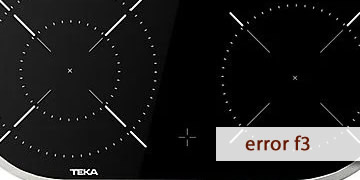
F3 Error on Teka Ceramic Hobs
Table of contents
What the F3 error usually indicates on a Teka ceramic hob
The F3 error on a Teka ceramic hob is usually associated with a problem in the temperature sensor circuit that monitors the power unit. Put simply: the hob stops trusting the thermal reading it uses to protect the electronics and, for safety, it blocks operation or cuts off zone activation.
This code can appear at different times, but it commonly shows up like this:
- The hob turns on, you try to select a zone, and shortly after F3 appears.
- After demanding use (high power for a while), the hob protects itself and shows the error.
- The fault is intermittent: some days it works and other days it locks without a clear pattern.
The most frequent causes tend to revolve around:
- Degraded thermal sensor (NTC) or inconsistent readings.
- Loose connector or poor contact in the wiring near the electronics.
- Excessive temperature under the hob due to poor ventilation, which eventually triggers protections and abnormal readings.
- In less common cases, an internal fault in the power module.
The key point: F3 usually points to the part that monitors the electronics’ temperature, not to a one-off “incorrect use”. That is why it is worth checking cooling and stability before assuming a major fault.
How to fix the F3 error and prevent it from coming back
A ceramic hob operates on mains voltage. Do not handle terminals or open the hob if you are not a technician. These steps help you rule out the most common causes and narrow down the issue.
- Stop using it and let the hob cool down properly
- Switch off all zones and wait 15–20 minutes.
- Avoid repeated resets while the cabinet is still hot.
If the error was triggered by high temperature, this cool-down is the first filter.
- Perform a full electrical reset
- Switch off the circuit breaker for the hob’s circuit.
- Wait 3–5 minutes (not just a few seconds).
- Restore power and test one zone at medium power.
- Check the cabinet ventilation (very important for ceramic hobs)
- Make sure nothing is pressed against the underside (a drawer packed to the top, papers, cloths, etc.).
- Check that the space is not “sealed” with no air intake/outlet.
- If there is an oven underneath, test the hob first with the oven switched off.
- Observe when F3 appears: cold start or after several minutes
- Cold and at start-up: usually points to the sensor/wiring/connector or the electronics.
- After some use: more often related to heat build-up and insufficient dissipation.
- Avoid forcing the hob while the error is recurring
- Do not use maximum power for long periods if F3 has already appeared.
- Do not chain on/off attempts trying to “make it work”.
When the sensor is failing, insisting only increases the likelihood of repeated cut-outs.
- When it makes sense to move to technical diagnosis
- F3 returns even when the hob is cold and the cabinet ventilation is good.
- The error appears on every attempt despite proper electrical resets.
- You notice abnormal behavior (abrupt shut-offs, zones not regulating properly, overheating smell).
A technician will typically check the NTC sensor, wiring continuity and connectors, and assess whether the fault is in the power module.
- Measures to prevent it from coming back
- Keep the space below clear and well ventilated.
- If you cook at high power for long periods, alternate zones and reduce power during extended runs.
- If the error is triggered by high ambient heat, avoid running the hob at “full power” continuously.
If F3 disappears after cooling and resetting, it was most likely a protection triggered by thermal conditions or a one-off reading. If it repeats easily, it is common to check the sensor and connections to prevent the fault from eventually making the hob unusable.