 Português (Portugal)
  Español (España)
  English (United Kingdom)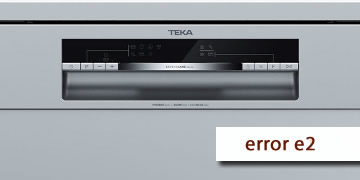
Error e02 in Teka dishwashers
Table of contents
Why error e02 appears in your Teka dishwasher
In many Teka dishwasher models, the e02 code is related to a problem with the water inlet. The appliance tries to fill the tub, but within a given time it does not reach the minimum level that the electronics consider correct, so it stops the programme and displays the warning.
In some Teka manuals this error is clearly described as a situation in which the dishwasher is not receiving water due to a cut in the supply, a closed tap or an issue in the inlet circuit. The appliance stays “waiting” for water to arrive and, if it does not, it protects itself by stopping the cycle.
The most common causes that may be behind the e02 error in a Teka dishwasher are:
- Shut or partially open water tap: the tap feeding the dishwasher may be closed, half open or seized up by limescale, greatly reducing the flow.
- No water or very low water pressure in the house: a general cut-off, work on the mains or insufficient pressure mean the appliance cannot fill within the expected time.
- Kinked inlet hose: if the inlet hose gets bent, stepped on or crushed when fitting the dishwasher, water struggles to enter or does not enter at all.
- Blocked inlet hose filter: at the connection between the hose and the tap there is usually a small metal filter. Over time it can become clogged with limescale, rust or grit and block the water flow.
- Activated AquaStop or safety hose: if the dishwasher has a hose with AquaStop and it has detected a leak, the safety device itself cuts off the water and prevents filling.
- Faulty inlet solenoid valve: this is the component that opens and closes the water supply to the dishwasher. If the coil burns out, it jams mechanically or receives an incorrect signal, the appliance cannot fill.
- Problems with the flow meter or fill sensor: in some models, a sensor counts how much water is entering. If the reading fails, the electronics may “think” that it has not filled enough and show e02.
- Occasional electronic glitch: in certain ranges, codes E01–E05 are grouped as control-related faults. A brief power cut or internal board issue may show up as this code.
Although the most frequent cause is a lack of water or something preventing it from reaching the interior correctly, you should not rule out a fault in internal components (solenoid valve, sensors or control board), especially if the error comes back after checking the installation.
Steps to fix error e02 in your Teka dishwasher
Before assuming there is a serious fault, it is advisable to follow a series of simple checks that often solve the e02 problem without needing replacement parts.
- Stop the programme and disconnect the dishwasher
If the e02 code appears in the middle of a cycle:- Press the on/off button to stop the programme.
- Wait a few seconds and unplug the dishwasher from the mains.
- Close the water supply tap that feeds the appliance.
- Check that there is water in the house and the tap is fully open
Before dismantling anything:- Open the kitchen tap and check that water comes out with normal pressure.
- Locate the dedicated tap for the dishwasher (usually under the sink) and make sure it is fully open. If it is very stiff, it may be seized by limescale.
- Inspect the route of the inlet hose
Gently move the dishwasher a few centimetres forward (if it is built-in, first remove the plinth and loosen the top brackets) and check:- That the inlet hose is not bent at a very sharp angle or crushed against the wall or cabinet.
- That there are no objects behind the dishwasher pressing on the hose.
- That the hose connection to the tap shows no leaks or severe corrosion.
- Clean the inlet hose water filter
At the joint between the dishwasher hose and the water tap there is usually a small filter:- Close the water tap if you have not already done so.
- Loosen the hose nut (place a cloth or small container underneath in case any water remains).
- Locate the metal mesh or filter inside the fitting and carefully remove it.
- Rinse it under the tap, removing limescale, sand or particles that may be blocking it.
- Reinsert it and screw the hose back on without overtightening.
- If your model has AquaStop, check the safety hose
Some Teka dishwashers have a special hose with a plastic box (AquaStop) or a bulge:- Look for signs of leaks or deformation on that box or hose.
- If the AquaStop has been triggered by an internal leak, it may cut off the water permanently until the hose is replaced.
- Reset the dishwasher and run a short cycle
Once the basic checks are done:- Open the water supply tap again.
- Plug the dishwasher in and switch it on.
- Select a short programme, such as a rinse or quick wash.
- Listen for the typical sound of water entering at the start of the cycle and see whether the error comes back.
- When to suspect the solenoid valve or control system
If, despite having good pressure, a kink-free hose and a clean filter, the e02 error appears again:- There may be a fault in the inlet solenoid valve (burnt coil, jammed mechanism or internal mechanical failure).
- The flow or level sensor may not be correctly reading the incoming water.
- You cannot rule out a control board fault that affects the fill command.
- Good practices to prevent error e02 from returning
To reduce the chances of seeing this code again:- Periodically check that the water tap opens and closes smoothly and that it is not leaking.
- Clean the inlet hose filter from time to time, especially if the water in your area has high limescale content.
- Avoid pushing the dishwasher too hard against the wall; leave some space so the hose does not get crushed.
- If there are frequent water cuts, wait until the supply is stable before starting long programmes.
The e02 error in a Teka dishwasher is usually related to a filling problem and, in many cases, can be solved by checking the water installation, the tap, the hose and the inlet filter. If, after these checks, the code persists, it is advisable to have a technician inspect the solenoid valve and the other components of the inlet circuit to avoid further damage and ensure safe operation of the appliance.