 Português (Portugal)
  Español (España)
  English (United Kingdom)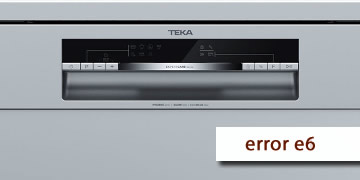
Error e6 in Teka dishwashers
Table of contents
What error e6 indicates in your Teka dishwasher
In most household Teka dishwashers, the e6 code is associated with a water leak inside the appliance. The machine detects that water is leaving the areas where it should be (tub and hydraulic circuit) and reaching the bottom safety tray, where there is a float or sensor that triggers the error and stops the dishwasher.
In practice, the dishwasher interprets that there is a risk of flooding and reacts accordingly: it stops the programme, may activate the drain pump to try to remove the water and displays the e6 code on the display or via a combination of LEDs, depending on the model.
Many users and service technicians agree that error e6 in Teka dishwashers is related to water leaking down into the base of the appliance, either from damaged hoses, worn seals or cracked components that end up filling the bottom tray and triggering the safety system.
The most common causes that can generate this code are:
- Leaks in internal hoses or drain pipes: a split hose, a loose clamp or a cracked fitting can gradually drip water down onto the base.
- Leaks in the hydraulic assembly or heat exchanger: cracks in the plastic block where water and detergent circulate, or in the water softener (salt tank), cause constant dripping during the wash cycle.
- Damaged tub or corrosion points: over time, rust or micro-cracks can appear in the tub, especially at joints and corners, eventually letting water seep into the bottom tray.
- Worn door gasket: a hardened, cut or deformed seal allows some of the water to escape towards the front and run down into the base of the dishwasher.
- Damaged spray arms: if a spray arm is split or warped, it can send jets of water directly against the door or side panels, forcing leaks through the seals.
- Poor installation or incorrect level: a dishwasher that is tilted too far forward or badly fitted can encourage water to move into areas where it should not be and escape through weak spots.
- Anti-leak system (tray and float) activated: when water reaches the bottom tray, it lifts a float that actuates a safety microswitch. Even a small leak will eventually fill the tray and cause the e6 error.
- Model-specific cases: in some particular Teka ranges, the e6 code may be related to the temperature sensor or other internal sensors. If the symptoms do not match a leak (no moisture visible, no water in the base, etc.), it is advisable to check the manual for your specific model.
In short, in most domestic scenarios the e6 error is telling you that the dishwasher has detected water where there should not be any and has stopped the cycle to avoid greater damage to both the machine and the kitchen cabinets.
How to deal with error e6 in your Teka dishwasher
When error e6 appears, the most important thing is to determine whether there is actually a water leak and, if so, where it is coming from. The following steps will help you get oriented before calling a technician.
- Switch off the dishwasher and shut off the water supply
As soon as you see the e6 code:- Switch off the dishwasher from the control panel.
- Unplug the appliance from the mains socket.
- Close the water supply tap feeding the dishwasher.
- Check for signs of moisture around the appliance
Before dismantling anything, look at:- The plinth area of the cabinet and the floor right in front of the dishwasher.
- The sides of the adjacent cabinets for swollen wood or water marks.
- Pull the dishwasher slightly out of the cabinet to access the base
If it is a built-in model:- Remove the lower plinth of the cabinet.
- Loosen the mounting screws that secure the dishwasher to the worktop or sides.
- Slide the appliance a few centimetres forward, taking care not to strain the hoses.
- Check for water in the bottom safety tray
In many Teka dishwashers, at the very bottom of the appliance there is a tray where any leaked water is collected, together with a float or sensor:- Use a torch to look from the front or side into the base area.
- If you see water accumulated in that tray, this is the most common cause of error e6.
- There is usually also a plastic or foam float that, when raised, actuates the anti-leak microswitch.
- Remove the water from the tray and dry the area thoroughly
With the appliance still unplugged:- Use sponges, cloths or a small manual pump to remove as much water as possible from the bottom tray.
- Dry, as far as you can, the area around the float and any visible components.
- Run a controlled test to locate where the water is leaking from
Push the dishwasher almost back into place, but leave some access to the sides or bottom:- Plug the appliance back in, open the water tap and select a short programme.
- During the first few minutes, use a torch to observe the lower area: drain pump, hoses, connections to the hydraulic assembly, inlet to the salt softener, etc.
- Try to see at what point the dripping starts: during filling, when water circulates through the spray arms, during the hot rinse, etc.
- If it leaks near the pump or drain hose, it is most likely a crack or loose clamp in that area.
- If the leak comes from the softener/salt unit or the side hydraulic assembly, the plastic may be cracked or the seals damaged.
- If the water seems to come from the upper front area and ends up in the base, check the door gasket and how the water from the spray arms hits the door.
- Check the door, gasket and spray arms
With the dishwasher switched off:- Inspect the door perimeter gasket: if it is cracked, deformed or very flattened, it may allow water to escape during the wash.
- Thoroughly clean the frame where the gasket seals, removing grease, limescale and detergent residue.
- Remove the spray arms and check that they are not split or cracked. If they have cracks, they may send direct jets onto the seals or door panel.
- Assess whether the leak is coming from structural components
If during the controlled test you see water escaping:- From the tub itself (crack or rusted-through point).
- From a side heat exchanger, hydraulic assembly or softener with visible cracks.
- From a moulded joint area that is difficult to dismantle.
- When to call a service technician
It is advisable to call a professional when:- The bottom tray fills with water again shortly after you have dried it.
- You cannot visually locate the leak, but the e6 error keeps reappearing.
- The leak comes from structural components (tub, softener, hydraulic assembly) or from hard-to-reach areas.
- You do not feel comfortable removing panels, handling electrical parts or working with water and electricity together.
- Tips to prevent future leaks and the e6 error
To reduce the likelihood of seeing this code again:- Check from time to time that there is no moisture around the plinth or under the dishwasher.
- Keep filters and spray arms clean to avoid internal overpressure caused by blockages.
- Avoid putting excessive weight on the open door (this can misalign hinges and seals).
- If you notice unusual dripping sounds during a cycle, investigate as soon as possible, before the bottom tray fills up.
Error e6 in a Teka dishwasher is usually the consequence of an internal leak that has triggered the safety system. Finding and fixing that water leak in time not only clears the error code, but also prevents more serious damage to the appliance and your kitchen furniture.