 Português (Portugal)
  Español (España)
  English (United Kingdom)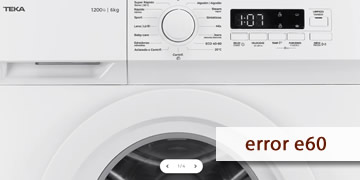
Error E60 in Teka washing machines
Table of contents
What does error E60 mean on a Teka washing machine?
Error E60 on Teka washing machines is usually linked to a motor system problem: the washer tries to move the drum, but the control board detects that the motor does not start properly, loses speed control, or operates outside safe parameters. For safety, the programme is interrupted to prevent damage to the motor or the control module.
As with other codes, the exact meaning can vary by model series, but if E60 appears along with symptoms such as the drum not turning, jerky rotation, stopping as the spin cycle begins, or unusual noises from the lower area, it’s generally best to focus your checks on load, drive/transmission, motor and the electronic control.
Common situations where E60 appears:
- The washer attempts to start and the drum does not move.
- The drum turns weakly, stops, and the error returns shortly after.
- The fault triggers when entering spin, when the motor needs to accelerate.
- You notice jerky movement or sudden speed changes right before it stops.
The most common causes behind error E60 on a Teka washing machine are:
- Overload or imbalance: the motor may protect itself if the load is too heavy or clumped to one side.
- Mechanical resistance: tired bearings, friction, a foreign object trapped between tub and drum, or a drum that no longer spins smoothly.
- Loose or damaged drive belt (if your model uses a belt): the motor turns but does not transmit movement properly to the drum.
- Worn carbon brushes (on brushed motors): the motor loses power, sparks, or fails when accelerating.
- Speed sensor (tachometer) / wiring: if the board cannot “read” speed correctly, it may stop for safety.
- Power control module: triac/relays/power stage faults (especially when the error repeats and is not related to the load).
In short: E60 usually warns that the motor is not behaving the way the washer expects. Sometimes it’s resolved by improving how the load is placed, but if it keeps happening you should look into the drive system, motor and electronics.
How to clear error E60 on your Teka washing machine
Before checking anything, switch the washer off and unplug it. If you notice a burning smell, sparking, smoke or very harsh noises, do not keep testing programmes: the safest option is to stop and move to a proper diagnosis.
- Do a clean reset
- Unplug the washer for 2–3 minutes.
- Plug it back in and select a short programme.
- If the error returns immediately, it points to a persistent issue rather than a one-off glitch.
- Reduce the load and rebalance the laundry
- Remove some items, especially heavy ones (blankets, large towels, thick jeans).
- Spread the items around the drum so they are not all on one side.
- Run a rinse with spin: if it works, the cause was likely overload/imbalance.
- Check the drum by hand (washer unplugged)
- Turn the drum several revolutions in both directions.
- It should move fairly smoothly. If you feel strong rubbing, hard spots or metallic noise, there’s likely a mechanical issue forcing the motor.
- Also check the door seal and the drum openings for trapped objects.
- If your model uses a belt, look for drive/transmission symptoms
- If the motor “sounds” like it’s running but the drum barely moves, the belt may be loose, off the pulley or damaged.
- Another sign: the drum spins too freely with little resistance, as if it’s “disconnected”.
- In that case, the fix is usually refitting or replacing the belt (preferably by a technician if you’re not experienced).
- Note when E60 appears: at start-up or during acceleration
- At start-up: often points to blockage, overload, belt issues, or a motor with low power (brushes/supply).
- During acceleration (spin): common with worn brushes, a speed sensor issue, or a power module that fails under higher demand.
- When it’s best to contact a technician
- E60 appears even with an empty drum or with 2–3 light garments.
- There are repeated jerks, constant stops, or abnormal noises near the motor area.
- You smell overheating or the washer stops abruptly each time it tries to turn.
In these scenarios, it usually requires testing the motor, brushes (if applicable), tachometer, wiring and control module with proper measurements. Forcing more cycles can end up damaging the electronics and make the repair more expensive.
- Good practices to prevent it from coming back
- Do not overload: respect the real capacity (wet heavy items can weigh much more).
- Mix large items with smaller ones to help the load balance during spin.
- If the washer vibrates excessively, stop and redistribute the laundry before trying again.
- If the drum no longer turns smoothly by hand, do not ignore it: it often signals a developing mechanical problem.
If you want, send me the exact model (the sticker is usually on the door frame or the rear panel) and I’ll tailor the article to that specific series to refine the E60 diagnosis even further.